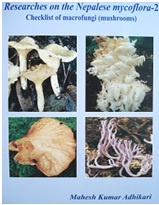
The investigation and study on the mycodiversity of the Nepalese Himalayan belt is the most neglected field. The gathering and study of fungi is an expensive, difficult, and tedious job in accessing the areas of explorations. Many taxa have remained unexplored and many new species are yet to be discovered. This book is the compilation of the result of investigations done on Nepalese alpine to tropical mycoflora. It is a new field in Nepalese Botany.
This book is an effort to throw light on the higher or larger macrofungi, whose fruiting bodies are seen by naked eyes during study and investigation. The chapters throw light on the list embracing the macrofungi (mushrooms), which fall into the groups Ascomycotina and Basidiomycotina.
Chapter Overview:
- Chapter 1: Introduction
- Chapter 2: List of Fungi
- Chapter 3: Ascomycota & Basidiomycota
- Chapter 4: Selected References
- Chapter 5: Index, Annex, and Photographs
Somewhere a comparative note for the field identification of the species concern has been provided to recognize the species in the field. The common names (oriental and western) of the species concern are also provided. The groupings and sub-groupings of the taxa are adopted after the 'Dictionary of Fungi' (2001) and the subject matters are so organized that anyone can easily find the required information without going through the whole book. Moreover, the book is presented in an easy-to-read style and incorporates 65 colored photographs and 35 B/W photographs.
Taxonomic Breakdown of Included Species:
| Group | Order | Family | Genera | Species |
|---|---|---|---|---|
| Ascomycota | 5 | 23 | 61 | 147 |
| Basidiomycota | 12 | 74 | 447 | 874 |
The aim of the book is to provide prompt findings of the published or unpublished species in the field, helping researchers recognize species on-site. Additionally, it ensures that while reporting, one must know about fungi reported to date, avoiding duplication in the publication of the taxa concerned and the results of investigations.
The book is hoped to benefit scientists, researchers, planners, students, amateurs, the mycophagous society, and its related people.